[PAPERS]
Provenance-Bound Industrial Discovery: Architecture of the Maverick Industrial Discovery Protocol
Maverick Labs · July 2026
Abstract
The Maverick Industrial Discovery Protocol (MIDP) is a layered pipeline for transforming public industrial source data into verified manufacturer records. Each candidate traverses sequential processing stages — from intake through archive admission and timed publication — with provenance recorded at every transformation. This document describes the architectural design: why raw web crawling is insufficient for trustworthy industrial intelligence, how staged uncertainty reduction works, and how auditability is preserved throughout the lifecycle.
I. The Engineering Problem
Industrial manufacturer intelligence is not a search indexing problem. A company name extracted from a trade directory carries different epistemic weight than a name confirmed on an official website after identity reconciliation. Conflating these states produces archive contamination: traders listed as manufacturers, duplicate entities under variant names, and claims without corroborating source references.
Raw web crawling amplifies this risk. Directory pages mix manufacturers, traders, and service firms. Aggregators infer websites from name patterns. Without provenance binding — recording what was observed, where, and under what confidence — an archive cannot be audited or trusted.
MIDP treats industrial discovery as a systems problem: reduce uncertainty through staged processing, bind every decision to evidence, and gate publication until admission criteria are satisfied.
II. Design Philosophy
Provenance at every transformation
Each processing stage appends to an append-only trace for the entity: validation outcomes, evidence references, routing decisions, and accumulated structured payload. The trace is the audit record.
Idempotent, retry-safe orchestration
Background jobs retry on failure. Layer outcomes are recorded idempotently so a retried step does not duplicate audit history or corrupt entity state.
Confidence-proportional publication
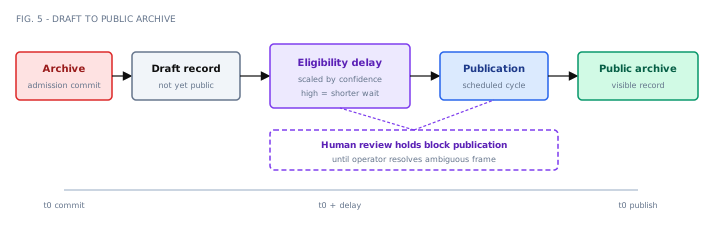
Archive admission creates draft records; public visibility is deferred by a delay scaled to classification confidence. Publication is a distinct lifecycle phase, not an immediate consequence of ingestion.
Source-agnostic ingestion
Registered sources declare connector type, trust tier, and crawl configuration. The pipeline consumes normalized candidates — not connector-specific field shapes — so new source categories integrate without restructuring downstream stages.
III. Run-Level Architecture
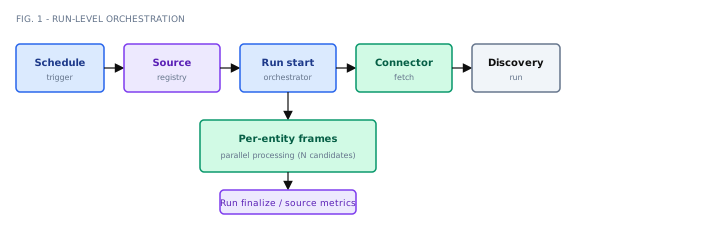
At run level, MIDP operates as a scheduled discovery cycle. A periodic trigger reads the source registry and initiates a run per active source. The source connector retrieves entity candidates up to a configured limit. Each candidate enters independent frame processing — one failure does not abort the run. After a completion window, run counters and source performance metrics are finalized.
Figure 1
IV. Processing Stages
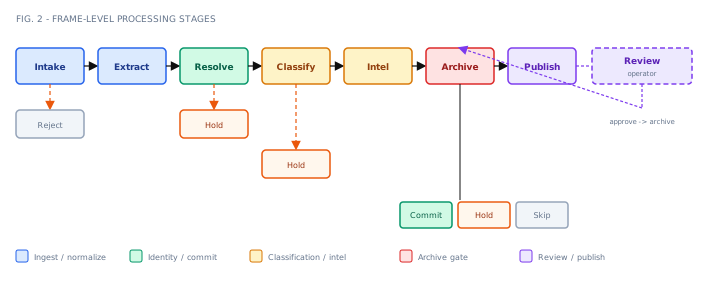
Each candidate traverses sequential stages. Each stage has a defined responsibility and reduces a specific class of uncertainty. Figure 2 shows the sequence with hold, reject, and review branches.
| Stage | Responsibility | Uncertainty reduced |
|---|---|---|
| Intake | Validate minimum identity signals; attach source evidence | Empty or malformed candidates |
| Extraction | Normalize connector output to canonical fields | Heterogeneous source shapes |
| Resolution | Match against existing archive by domain and name | Duplicate entities |
| Classification | Assess industrial relevance and manufacturer signals | Non-manufacturers, irrelevant entities |
| Intelligence | Retrieve and analyze official website content | Unverified directory claims |
| Review | Human judgment on ambiguous routing outcomes | Edge cases below automation threshold |
| Archive admission | Gate verified archive entry on evidence quality | Archive contamination |
| Publication | Timed release of draft records to public archive | Premature low-confidence visibility |
Figure 2
Intake and extraction
Intake rejects candidates without a usable identity. Source evidence — the raw record and provenance URL — is attached with a confidence weight derived from source trust tier. Extraction maps connector-specific fields into a normalized payload consumed by all downstream stages.
Resolution
Resolution compares the normalized candidate against existing archive records using domain, normalized name, and geographic signals. Clear matches route to existing-entity handling; ambiguous matches are held rather than creating duplicate records.
Classification
Classification applies manufacturer and industrial relevance models to name and context text. Routing outcomes direct candidates toward enrichment, hold, human review, or exclusion from manufacturer archive paths.
Intelligence and evidence correlation
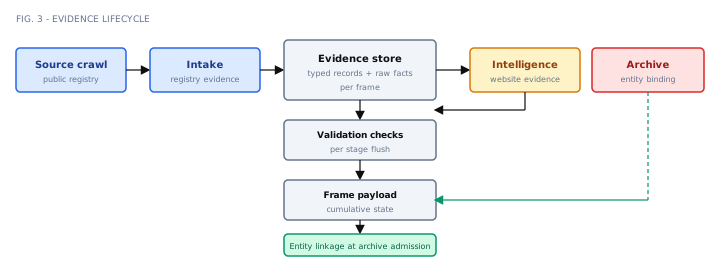
When a domain is available, the intelligence stage retrieves public website documents and correlates extracted text with directory claims: manufacturing signals, certification mentions, product vocabulary. Website evidence is appended to the entity trace. An admission assessment synthesizes relevance, manufacturer classification, website confidence, and identity consistency.
Figure 3
V. Archive Admission
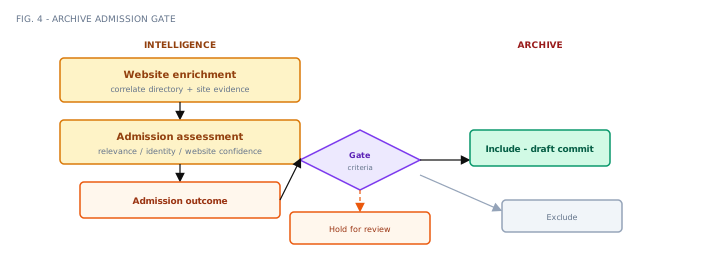
Archive admission is an evidence-based gate. Candidates that satisfy admission criteria — sufficient website confirmation, consistent identity, acceptable purity signals — may commit as draft archive records. Candidates that fail criteria are excluded or held for operator review. Admission is assessed after intelligence enrichment, not at raw ingestion.
Figure 4
VI. Publication
Committed records enter a draft state with a publication eligibility timestamp scaled to confidence. A separate publication cycle promotes eligible drafts to the public archive. Frames under human review block automatic publication until resolved.
Figure 5
VII. Data and Audit Model
MIDP persists run metadata, per-entity frames, layer outcome records, validation checks, errors, and typed evidence rows. Evidence categories include registry observations, website content, certification claims, fair exhibitor data, and network mentions. Admission state is inferred from layer traces and publication flags — preserving full decision history rather than collapsing it to a single timestamp.
MIDP is designed as provenance-bound industrial discovery: staged uncertainty reduction, evidence correlation before archive entry, and timed publication separated from ingestion. The architecture prioritizes auditability over throughput — each published manufacturer record should be traceable to the sources and stages that produced it.